Chapter 4 Fieldwork Procedures and Response Rate
4.1 Introduction
The NTS is a continuous survey with fieldwork taking place throughout the year. Traditional doorstep recruitment was used, preceded by the interviewers sending out an advance letter to each household. F2F was the primary approach for 2025. Interviewers could offer a telephone interview as a back-up only in exceptional circumstances for respondents who have a weakened immune system. This was known as the phone back-up (PB) option. The travel records (also known as diaries) were filled in by the respondents themselves. For PB cases respondents could complete their own digital diary, or it would instead be filled in by the interviewers over the telephone.
The computer assisted personal interviewing (CAPI) questionnaires on the interviewer laptops were designed and implemented using the software system Blaise. A single Blaise instrument was used for the household, individual, vehicle and administrative sections of the questionnaire.
A separate Diary Entry System (DES) was written in Visual Basic. The DES was updated for 2025 to process the digital diary data. After checking the diaries, the interviewer was required to approve each digital diary then submit the household. Once submitted, the diary data was transferred from the digital diary to NatCen via an Application Programming Interface (API).
Selected CAPI variables were extracted and loaded into the NatCen field management system from where they were referenced by the DES. This process provides contextual information from the CAPI interview for those people inputting and editing travel diary data.
Note: for this chapter, comparisons of the 2025 data against 2024 data and 2019 data are included, as data from the pandemic years (2021 and 2020) was atypical for the NTS time series, and the methodology for 2022 remained different for part of the year, whereas 2019 continues to provide a robust baseline.
4.2 Overview of the digital travel diary
In 2025, the NTS introduced a digital-first approach to placing the travel diary for the first time, offering a digital diary as the primary method of diary completion (see Appendix E). This approach involved the interviewer introducing the diary as an online form for respondents to fill in themselves. The paper travel diary (see Appendix F1 and Appendix F2) remained available for respondents who were unable or unwilling to complete a digital diary.
Table 4.1 shows the proportion of households that completed the digital diary and paper diary in 2025. For fully co-operating households, 74% completed the digital diary compared to 26% who completed the paper diary. 4 households completed both digital and paper diaries (0.04%), known as a mixed-mode household.
Note: figures in the tables below may not total 100% due to rounding.
Table 4.1: Mode of diary completion for fully co-operating households (2025)
| Case type | Digital diary | Paper diary | Mixed-mode | Total |
|---|---|---|---|---|
| Fully co-operating | 74% | 26% | 0% | 100% |
| Base (households) | 6,669 | 2,364 | 4 | 9,037 |
Table 4.2 shows socio-demographic characteristics by household mode of diary completion for fully co-operating households. The distribution of households was broadly similar across deprivation deciles and household tenure. The largest differences were by household size, with single-person households accounting for a higher proportion of households with no digital diary completions (50% compared with 25%). Households in the most deprived decile also accounted for a higher proportion of households with no digital diary completions (10% compared with 7%), while those in the least deprived decile accounted for a lower proportion (8% compared with 12%).
Table 4.2: Mode of diary completion for fully co-operating households by socio-demographic characteristic (2025)
Note: figures in the tables below may not total 100% due to rounding.
| Characteristic | At least one digital diary completed in household | No digital diaries completed in household |
|---|---|---|
| Index of multiple deprivation: 1st decile (Most deprived) | 7% | 10% |
| Index of multiple deprivation: 2nd decile | 8% | 10% |
| Index of multiple deprivation: 3rd decile | 9% | 9% |
| Index of multiple deprivation: 4th decile | 9% | 9% |
| Index of multiple deprivation: 5th decile | 10% | 10% |
| Index of multiple deprivation: 6th decile | 11% | 10% |
| Index of multiple deprivation: 7th decile | 12% | 12% |
| Index of multiple deprivation: 8th decile | 11% | 12% |
| Index of multiple deprivation: 9th decile | 11% | 9% |
| Index of multiple deprivation: 10th decile (Least deprived) | 12% | 8% |
| Base (households) | 6,673 | 2,364 |
| Household size: One | 25% | 50% |
| Household size: Two | 40% | 35% |
| Household size: Three | 15% | 7% |
| Household size: Four | 15% | 5% |
| Household size: Five or more | 6% | 3% |
| Base (households) | 6,673 | 2,364 |
| Household tenure: Owns or part owns | 71% | 68% |
| Household tenure: Does not own or part own | 29% | 32% |
| Base (households) | 6,667 | 2,354 |
Table 4.3 shows individual-level socio-demographic characteristics by diary mode for fully co-operating cases. The distribution of individuals was broadly similar by urbanicity and sex. The largest differences were by age, disability status and employment status. Individuals completing a paper diary included a higher proportion aged 70 and over (44% compared with 14%), those with day-to-day activities limited a lot by a long-term condition (18% compared with 8%), and those who were economically inactive (68% compared with 38%). Individuals completing a digital diary included a higher proportion who were employed (61% compared with 31%) and who held a Level 4 qualification or above (55% compared with 41%).
Table 4.3: Mode of diary completion for fully co-operating cases by socio-demographic characteristic (2025)
Note: figures in the tables below may not total 100% due to rounding.
| Characteristic | Digital diary | Paper diary |
|---|---|---|
| Urbanicity: Lives in an urban area | 82% | 81% |
| Urbanicity: Lives in a rural area | 18% | 19% |
| Base (individuals) | 15,993 | 4,197 |
| Age: 0 to 9 | 11% | 6% |
| Age: 10 to 19 | 13% | 6% |
| Age: 20 to 29 | 9% | 4% |
| Age: 30 to 39 | 13% | 6% |
| Age: 40 to 49 | 13% | 7% |
| Age: 50 to 59 | 13% | 10% |
| Age: 60 to 69 | 14% | 16% |
| Age: 70 to 79 | 10% | 24% |
| Age: 80 and over | 4% | 20% |
| Base (individuals) | 15,993 | 4,197 |
| Sex: Female | 51% | 54% |
| Sex Male | 49% | 46% |
| Base (individuals) | 15,982 | 4,197 |
| Disability status: No long-term conditions (LTCs) | 74% | 58% |
| Disability status: LTCs and day-to-day activities not limited | 8% | 9% |
| Disability status: LTCs and day-to-day activities limited a bit | 10% | 15% |
| Disability status: LTCs and day-to-day activities limited a lot | 8% | 18% |
| Base (individuals)* | 15,163 | 4,075 |
| Highest educational qualification: Level 4 or equivalent and above | 55% | 41% |
| Highest educational qualification: Below Level 4 or equivalent | 45% | 59% |
| Base (individuals)** | 11,919 | 2,946 |
| Employment status: Employed | 61% | 31% |
| Employment status: Unemployed | 1% | 1% |
| Employment status: Economically inactive | 38% | 68% |
| Base (individuals)** | 12,912 | 3,780 |
| Marital status: Divorced, widowed or separated | 13% | 28% |
| Marital status: Married or in civil partnership | 55% | 49% |
| Marital status: Never married or in civil partnership | 32% | 23% |
| Base (individuals)** | 12,912 | 3,780 |
| Ethnic background: Not White | 19% | 13% |
| Ethnic background: White | 81% | 87% |
| Base (individuals) | 15,967 | 4,185 |
*Asked of those aged 5 and over **Asked of those aged 16 and over
Note: Urbanicity was recorded at the household level and applied to individual cases. All other variables in Table 4.3 were recorded at the individual level.
Several time-saving features were included in the digital diary to make the task of completing the diary less burdensome for respondents, such as return, repeat, and share journey buttons.
Regardless of whether digital or paper diaries were used, the interviewer would return to the household for the pick-up visit to check and edit all diaries, and to complete the short pick-up interview. See section 4.14 for more details on the pick-up interview.
For PB cases, the interviewer would set-up a digital travel diary for the respondent to complete themselves. For some cases the interviewer would instead collect the information from them over the phone and populate the digital diary on behalf of the respondent.
The parallel run highlighted the need to strengthen interviewer confidence in using technology and to streamline digital-first fieldwork processes. In response, 3 key developments were implemented for 2025:
a QR code for transfer of data from the CAPI questionnaire to the digital diary system
expanded interviewer training, including a module for basic technical literacy
a dedicated team staffed by trained members in NatCen’s Operations Department who provided a fieldwork helpline while expert interviewers were trained as Project Champions.
These and other improvements are described in the relevant sections below.
For further details on the parallel run, see digital diary parallel run report.
4.3 Interviewer briefings
In 2025 there were 2 types of briefings where interviewers were briefed by NatCen’s research team. 2025 was the first year since 2020 where all briefings returned to in-person.
Prior to attending any 2025 briefing, all interviewers were required to attend a mandatory online training session to ensure a basic level of technical literacy. The training ensured interviewers knew how to use a QR code and tether their mobile phone to their laptop for purposes of reviewing the digital diary.
New interviewers attended a 2-day briefing which covered all aspects of the survey, including the demonstration of a dummy interview in the CAPI program, as well as role-play exercises to practise doorstep technique and the set-up and checking of digital and paper diaries. New interviewers were required to study the definitions manual and complete a short test on how the diary should be filled in and the type of probing needed to gain the required level of accuracy and specificity.
Interviewers who had completed a NTS point (also known as an assignment) over the previous 12 months attended a refresher briefing shortly before the start of the survey year. Because a substantial amount of information on the digital diary was introduced, this briefing was extended to 2 days and focused primarily on the digital diary, alongside other updates for the 2025 survey.
NatCen interviewers attending a briefing in 2025 were given access to the digital diary system prior to attending the briefing. Interviewers were granted a different level of access to the digital diary system than respondents. Specifically, interviewers had access to a training dashboard within the digital diary, which included training modules and videos designed to support them before, during, and after the briefing.
In preparation of the briefing, all interviewers completed a pre-briefing exercise. This involved watching a training video on the interviewer dashboard and filling out the digital diary themselves, using details from their own journeys in the days leading up to the briefing.
A large part of each briefing was spent practising how to use the digital diary. In 2025, briefings were held in smaller groups with more research staff present. This meant interviewers could get more one-to-one help and be sure they could support respondents using the digital-first approach.
Interviewers were also shown how to promote time-saving features like “repeat a journey” and “share a journey”. Interviewers could go back and re-take training modules at any time to refresh their knowledge and feel more confident using the digital tools.
4.4 Supporting interviewers’ use of digital tools
To ensure the quality of the study was upheld with the introduction of the digital diary to the main NTS fieldwork sequence, some changes were made to interviewer guidance and support.
7 experienced NTS interviewers were trained to become an NTS Project Champion. Their role was to help build interviewers’ digital confidence, provide one-to-one support, encourage the digital-first approach, and provide general NTS expertise on how to carry out the project. The Project Champions supported the NTS research team by providing fieldwork guidance in briefings and updates on field-related queries.
NatCen’s freephone team had a new supporting role with respect to the digital diary. Their role was to deal with urgent issues with the digital diary whilst out in field, including rapid response to technical queries from interviewers, for example if QR code was not generated in CAPI or troubleshooting of digital diary issues/error messages. 3 members of NatCen’s freephone team attended a one-day in-person briefing delivered by the research team to learn about the digital diary and how to handle support queries and feedback. Interviewers and respondents were also able to log support and feedback in the digital diary which would be picked up and handled by the freephone team. These items were then triaged and assigned to either NatCen, the digital diary supplier, or DfT.
As in previous years, new interviewers also had the support of their launch supervisor, an experienced NTS interviewer who accompanies new interviewers when they first go out in field door knocking and interviewing.
4.5 Questionnaire and document despatch to interviewers
The Operations Department made the sampled addresses and the CAPI questionnaire available to the interviewers for download onto their laptops via a secure broadband connection before the start of each quota month. The relevant NTS materials were despatched to the interviewers by post.
Any queries about transmission or other technical matters were dealt with by a helpline run from the Operations Department during working hours. Laptop maintenance was handled by a separate IT support department within NatCen.
4.6 Interviewer start dates and points
Interviewers were assigned to start fieldwork on different dates to ensure that interviewing was evenly spread across the year. The same principle applied to the travel week start dates, ensuring that the data recorded in the travel diaries was also spread evenly across the year, which is further underpinned by the fixed travel week allocation method used.
Interviewer points were allocated evenly across a quarter, rather than by month. When allocating points to quota months it is done in such a way a naturally representative sample is distributed for each quarter. See sections 3.6 and 3.7 for further information.
4.7 Contacting respondents
Interviewers were given advance letters to send to the selected addresses ahead of their first doorstep call (see Appendix B). For NTS 2025, the advance letter broadly mirrored the NTS 2024 advance letter. The letters included a space for interviewers to write in their name so that respondents knew who would be calling and to make the letters more personal.
From June 2004 to December 2024, a book of first-class stamps was included with the advance letter as a gesture of goodwill to encourage respondents to take part. In 2025, due to the rising cost of stamps alongside reduced use of them, the stamps were replaced with a £10 Post Office voucher. The Post office voucher was printed as a barcode on the bottom of the advance letter.
The advance letter gave some general background to the survey and explained its importance, some of its uses, and how the household had been selected. It also stated that each respondent would receive a £5 shopping voucher if all household members completed the survey.
Interviewers were notified of any refusals made to the Operations Department as a result of the advance letter being responded to by the residents of the sampled address. Interviewers were not required to visit these addresses and they did not count against interviewers’ individual response rates. However, they were classified as non-response (office refusals) in calculating the overall response to the survey.
A few days after the advance letters had been sent, interviewers contacted respondents by personal visit. Interviewers were required to make a minimum of 6 calls (that is, personal visits to the address) and to make sure that the days and times of these calls varied to maximise the chance of making contact with the selected household. If there was still no contact, only then could an interviewer return a case as a ‘non-contact’. Interviewers were also given a non-contact letter (which has been in place since November 2008) to post through the door of addresses where contact could not be made after 5 or 6 attempts (see Appendix C). The non-contact letter offered the household a further opportunity to learn about the NTS and to let NatCen’s Operations Department know if they wanted to take part. The changes that were made to the advance letter for NTS 2025 were also mirrored in the non-contact letter where relevant.
As in previous years, interviewers were also given information leaflets about the study (see Appendix D) and the NTS 2023 Factsheet so that, when necessary, they could demonstrate to respondents the type of data collected by the NTS. This was intended to help boost response and make the survey easier to sell on the doorstep.
4.8 Confidentiality
Respondents were informed in the advance letter that their participation was voluntary and that any information they provided would remain confidential and would not be passed on to anyone outside NatCen or the statistics section at DfT in a form that could be used to identify them. Respondents were provided with a telephone number and an email address for NatCen’s Operations Department that they could contact if they had any queries. Any substantive queries or complaints were subsequently passed on to researchers to deal with.
4.9 The placement interview
The first stage of interviewing consisted of the placement interview, using the CAPI questionnaire. This was conducted with all household members and consisted of 3 sections.
The household questionnaire was asked of the Household Reference Person (HRP), which is the householder with the highest income, or their spouse or partner. In exceptional cases the household questionnaire could be asked of another responsible adult aged 16 or over.
The individual questionnaire was asked of each household member, including children (although proxy information was always collected for children under 11 years old). A maximum of 10 people could be included. On the extremely rare occasions when interviewers encountered a household with more than 10 members, they were instructed to select the oldest 10 to take part in the interview, and to ensure that all vehicle owners were included.
The vehicle questionnaire was asked of the main driver for each vehicle in the household. A maximum of 10 vehicles could be recorded.
The percentage of individuals in 2025 who were interviewed in-person or by proxy for the placement interview (as well as those not interviewed) is shown in Table 4.4. The table is broken down by age into the 2 main age groups:
those aged under 16 (defined as a ‘young person’)
those aged 16 or over (defined as an ‘adult’)
Comparable figures for 2024 and 2019 are shown in Tables 4.5 and 4.6.
Table 4.4 shows that a high proportion of the individuals aged 16 or over were interviewed in-person in 2025 (67%), which is very similar to the proportion interviewed in-person in 2019 before the pandemic (70%) as shown in Table 4.6. The vast majority of individuals aged under 16 were interviewed by proxy in 2025 (97%), which is higher compared to the proportion interviewed by proxy in 2019 (85%).
Note: figures in the tables may not total 100% due to rounding.
Table 4.4: Method of individual interview at placement, by age (2025)
| Method of interview | Aged under 16 (young person) | Aged 16 or over (adult) | Total |
|---|---|---|---|
| In-person | 2% | 67% | 56% |
| Proxy | 97% | 32% | 44% |
| Not interviewed | 1% | 1% | 1% |
| Base (individuals) | 4,399 | 20,909 | 25,308 |
Table 4.5: Method of individual interview at placement, by age (2024)
| Method of interview | Aged under 16 (young person) | Aged 16 or over (adult) | Total |
|---|---|---|---|
| In-person | 2% | 68% | 57% |
| Proxy | 96% | 31% | 42% |
| Not interviewed | 2% | 1% | 1% |
| Base (individuals) | 3,490 | 17,122 | 20,612 |
Table 4.6: Method of individual interview at placement, by age (2019)
| Method of interview | Aged under 16 (young person) | Aged 16 or over (adult) | Total |
|---|---|---|---|
| In-person | 15% | 70% | 59% |
| Proxy | 85% | 30% | 41% |
| Not interviewed | 0% | 0% | 0% |
| Base (individuals) | 3,163 | 12,920 | 16,083 |
4.9.1 The 2025 NTS questionnaire
Each section of the placement interview covered a number of different topics:
The household questionnaire included:
the household grid
questions about home deliveries and food shopping
questions about children’s travel to school
the household vehicles grid
The individual questionnaire included questions about:
disabilities that affect travel
methods of transport used
walking
cycling
e-scooter
driving licences
internet use
(self-completion section) satisfaction with transport services, and perceptions of one’s own social isolation
education, paid work and journey planning
last paid job
income
location of work
travel to work
working at home
ease or difficulty of travelling to work
transport difficulties
road accidents involving adults
road accidents involving children
special tickets or passes
long-distance journeys
permission for re-contact for follow up
The vehicle questionnaire included questions about:
the vehicle registration number
vehicle details
parking
mileage
Note: The coding of Standard Occupational Classification was carried out in 2025 according to the 2020 system.
A new section was added to the questionnaire to establish each household’s diary completion mode. The digital diary was offered as the primary option for most households. However, a paper diary was provided where households had no internet access, no email address, or insufficient technical literacy. In some cases, households used a combination of modes (referred to as mixed-mode) to ensure the diary was completed by the respondent wherever possible.
The questionnaire specification is provided in Appendix A3, and an overview of how to interpret the questionnaire specification is provided in Appendix A1. Additionally, the questionnaire show cards are provided in Appendix I for reference.
Long-distance journeys
The NTS collects details about any long-distance journeys, defined as trips of 50 miles or more made within Great Britain. Where journeys of this type occur during the allocated travel week, these are simply recorded in the travel diary as usual.
Additionally, respondents are asked about long-distance journeys in the placement interview itself, but relating to a different (earlier) 7-day period. The week for which respondents were asked about long-distance journeys was normally the 7 days preceding the placement interview. However, in cases where the travel week was allocated to start date before the placement interview, the 7 days were instead taken to be the week preceding the start of the travel week. In total, a maximum of 40 long-distance journeys could be recorded during the interview.
Changes in 2025
The changes made to the NTS questionnaire in 2025 were as follows:
change in the placement of the existing question on vehicle fuel type which were asked at the household level, compared to previously being asked at the individual vehicle level
change in the placement of the existing questions on vehicle charging which were asked at the household level, compared to previously being asked at the individual vehicle level
new question on sexual identity was added to the CASI section
new questions to establish the mode of diary completion for each respondent
new questions to guide the interviewer through the process of setting up a household on the digital diary system, either through using a QR code embedded in the CAPI program or manual set-up
All changes to the questionnaire for 2025 are detailed in Appendix A2 and a summary of all questionnaire changes since 2002 is provide in Appendix A4.
Rotated questions
From 2002, some questions were designated to be ‘rotated’, such that they would be asked every other year. For 2025, the biennial rotating questions in Module B (odd years questions) were asked, and the questions in Module A (even years questions, last asked in 2024) were taken out.
Module B (odd years) included questions about:
food shopping:
Usual method of food shoppingchildren’s travel to school:
Barriers of children walking to school more and what would encourage more walking to school; and reasons for travelling to and from school with an adultdisabilities that affect travel:
Use of powered or manual wheelchair and how often it is used; whether a respondent is a carer and time spent caring; and prevalence of special transport services and usage of any of these special serviceswalking:
Barriers to walking more and what would encourage more walking in local areasdriving licenses:
Reasons for not driving among those without a provisional licence; and likelihood to learn to drivetravel to work:
Types of road used to travel to work; are respondents the driver or passenger travelling to work and how often is a lift given or received; and place of parking when driving to workworking from home:
Days of the week normally working from home; and extent to which it is possible to work from home and how much can be completed from home
For reference, Module A (even years) included questions about:
cycling:
Barriers to cycling; and what would encourage more cyclingdriving licenses:
Reasons for not driving currently among those with a licence; reasons for no longer holding a licence; and age last droveease or difficulty of travelling to work:
Difficulties with travelling to or from work by car, van, motorbike, scooter, or moped or by public transport; how easy is it to make journey to work, not using a car, van, motorbike, scooter, or moped; and what method of transport would they use insteadtransport difficulties:
Type of transport respondent has difficulty with:difficulties when travelling to the doctor’s surgery or hospital
difficulties experienced when visiting friends or relatives or other social activities
difficulties experienced when taking children to school or university
difficulties experienced when travelling for other purposes
parking:
Location of parking for vehiclesmileage:
Purpose and miles driven outside of Great Britain
Self-completion questions
Since 2017, attitudinal questions were asked of one member of the household aged over 16, administered by CASI. This member was randomly selected by CASI program among the adults of the household present during the interview (proxy respondents could not be selected). See section 3.5 for more details on how the random selection was made.
The respondent completed the section on their own, using the interviewer’s laptop. The questions asked about (a) the respondent’s satisfaction with transport services, and (b) their own perception of how socially isolated they were.
4.9.2 Harmonised questions
A number of harmonised questions are used in the NTS to allow users of the data to compare NTS data with those from other social surveys. These questions are listed in Table 4.7, with the harmonised question name shown against the equivalent NTS question name. The final column of the table shows when the question was introduced into the survey and also provides additional information if the question has changed since that time.
Table 4.7: Harmonised questions used in the 2025 NTS
| Harmonised question name | NTS question name | Year introduced |
|---|---|---|
| Sex | Sexfw | 2024, question was updated in 2024. The 1998 ‘Sex’ variable continues to exist as a background variable in Blaise.) |
| Age | AgeIf | 1998 |
| Date of birth | Birth | 2000 |
| Marital status | MaritalStat | 2013, with answer categories amended in 2023 |
| Living arrangements | LiveWithN | 2013 |
| Ownership of accommodation | Hhldr | 2002, with answer categories amended in 2003 |
| Joint ownership | HiHNum | 2002 |
| Ethnic group | EthGroupB | 2001, with answer categories amended in 2024 and headings for answer categories amended in 2022 |
| Length of residence | HLongA | 1998 |
| Relationship to head of household | RelHoH | 1998 (question now asked as relationships of household members) |
| Relationships of household members | Relation | 2013, with answer categories amended in 2013 |
| Religion | Religion | 2022 |
| Accommodation type | Accom | 2000 |
| House type | HseType | 2000 |
| Flat type | FltTypN | 2000 |
| Other accommodation | AccOth | 2000 |
| Housing tenure | Ten1 | 1998, with answer categories amended in 2013 |
| Car ownership | UseVcl | 1998, with answer categories amended in 2003 and question text amended in 2004 |
| Vehicle type | TypeVcl2 | 1998, with answer categories amended in 2003 (question was deleted in 2004, and has since been imputed using TypeVcl2) |
| Company car | PrivVcl | 1998, with question text amended in 2009 |
| General health | GenHeal | 2017 |
| Length of residence | HLongInd | 2017 |
| Home deliveries | Deliv1 and Deliv2 | 2024 |
| In employment | Wrking | 1998 |
| Training scheme | SchemeET | 1998 |
| Away from work | JbAway | 1998 |
| Own business | OwnBus | 1998 |
| Relative business | RelBus | 1998 |
| Looking for work | Looked | 1998 |
| Starting work | StartJ | 1998 |
| Inactive | YinAct | 1998 |
| Industry | IndD | 1998 |
| Job title | OccT | 1998 |
| Job description | OccD | 1998 |
| Job status | Stat | 1998 |
| Paid employment | EverWk | 1998 |
| Date of leaving last job | DtJbl | 1998 |
| Supervising employees | SVise | 2001 |
| Organisation size | EmpNo | 1998 |
| Self-employed | Solo | 1998 |
| Number of employees | SENo | 1998, with answer categories amended in 2003 |
| Full or part time work | FtPtWk | 1998 |
| Long-term unemployed | HowLong | 2004 |
| Educational qualifications | EdAttn1 | 2005 |
| Professional or vocational qualifications | EdAttn2 | 2005 |
| Highest qualification | EdAttn4 | 2005 |
| Internet access | OnlineN | 2013, with answer categories amended in 2013 |
| Important factors when buying a car or van | CarStyle | 2024 |
| Well-being | LackComp | 2019 |
| Well-being | LeftOut | 2019 |
| Well-being | Isolated | 2019 |
| Well-being | Lonely | 2019 |
| Disabilities that affect travel | Heallll | 2018 |
| Disabilities that affect travel | ImpCat1 to ImpCat10 | 2018 |
| Disabilities that affect travel | LimitAct | 2018 |
4.9.3 Length of the placement call
The average length of the placement call (that is, the placement interview plus the time taken to explain and, where necessary, complete the first days of the diary) for all households was just under 59 minutes in 2025, and varied according to household size, as shown in Table 4.8. Comparable figures for 2024 and 2019 are shown in Tables 4.9 and 4.10. These tables show the average time for different household sizes and the base figures for each row are also shown for reference in the final column.
As expected, Table 4.8 shows that the mean length of the placement call in 2025 tended to be longer for larger households. For example, the mean length for a single-person household was 47.46 minutes, and then 61.23 minutes for a 2-person household. The longest mean time was 175.33 minutes for households with 10 people.
Most mean lengths have increased slightly in 2025 compared to 2024 and 2019 as shown in Table 4.9 and Table 4.10 respectively. The slight increase in the average length of the placement call can be explained by the additional questions in the questionnaire included for the digital diary placement.
Table 4.8: Mean length of placement call (in minutes), by household size (2025)
| Number of people in household | Mean length (minutes) | Base |
|---|---|---|
| 1 | 47.46 | 3,279 |
| 2 | 61.23 | 4,176 |
| 3 | 63.43 | 1,509 |
| 4 | 67.57 | 1,437 |
| 5 | 71.29 | 416 |
| 6 | 74.24 | 141 |
| 7 | 79.87 | 38 |
| 8 | 82.33 | 18 |
| 9 | 125.75 | 4 |
| 10 | 175.33 | 3 |
| All households | 58.96 | 11,021 |
Table 4.9: Mean length of placement call (in minutes), by household size (2024)
| Number of people in household | Mean length (minutes) | Base |
|---|---|---|
| 1 | 43.88 | 2,804 |
| 2 | 57.36 | 3,722 |
| 3 | 61.24 | 1,346 |
| 4 | 65.21 | 1,187 |
| 5 | 67.59 | 389 |
| 6 | 74.91 | 115 |
| 7 | 91.89 | 36 |
| 8 | 67.73 | 11 |
| 9 | 110.40 | 5 |
| 10 | 78.33 | 3 |
| All households | 55.74 | 9,618 |
Table 4.10: Mean length of placement call (in minutes), by household size (2019)
| Number of people in household | Mean length (minutes) | Base |
|---|---|---|
| 1 | 40.41 | 1,879 |
| 2 | 54.77 | 2,522 |
| 3 | 60.69 | 968 |
| 4 | 64.04 | 958 |
| 5 | 65.23 | 273 |
| 6 | 69.08 | 79 |
| 7 | 71.79 | 24 |
| 8 | 69.50 | 6 |
| 9 | 80.20 | 5 |
| 10 | 89.33 | 3 |
| All households | 53.63 | 6,717 |
4.10 Allocation of Travel Weeks
Respondents were required to record their journeys in the digital or paper travel record for a period of 7 days (the period known as the travel week). Interviewers were given pre-selected lists of travel weeks, and from these lists the travel weeks were allocated to households by the interviewers using a methodical and unbiased process whenever they reached a definitive outcome.
To achieve this, each quota month was assigned a non-overlapping sequence of 30 to 31 travel week start dates. Individual interviewers were given a bespoke list (the ‘Travel Week Allocation Card’) of 22 travel week start dates, each of which was selected at random. This was achieved in such a way as to ensure, as far as possible, that an equal number of travel weeks would begin on each day in that month’s sequence (that is, evenly spread across all the interviewers working on a point belonging to that particular quota month). This means that it was possible to capture not only variations in travel behaviour within a month, but also differences across days of the week.
Because the number of trips that respondents record often falls away as their travel week goes on, the selection and allocation processes have been designed so that an approximately equal number of travel weeks start on each of the 7 days of the week. If, for example, all travel weeks were to start on Mondays, results would be biased toward travel behaviour on Mondays, Tuesdays and Wednesdays, whereas Saturday and Sunday travel behaviour would be under-represented.
Interviewers working on the 2025 survey were instructed to use the traditional ‘fixed travel week’ allocation method. This meant assigning the first travel week in their Travel Week Allocation Card list to the first address at which they reached a definitive outcome. They would then assign the next travel week on their list to the second address at which they reached a definitive outcome, and so on.
This method was applied universally, with the exception that when interviewers had to allocate a travel week that was in the past in relation to the interview itself they would therefore need to skip any travel weeks that started more than 2 days before the interview, and instead allocated the first travel week available on their list that started within 2 days before the interview. This exception exists to minimise the risk that respondents forget to include journeys or forget the specific details of journeys because the travel took place too far in the past for them to remember correctly. However, typically most travel weeks would start in the future in relation to the interview, especially if the interviewer had started their fieldwork as early as possible and did not suffer any unforeseen delays to their fieldwork progress.
Definitive outcomes include all the non-productive outcome types, such as deadwood addresses, refusing households, and any other type of non-participating address. For participating households, a definitive outcome was reached (that is, for the purpose of allocating a travel week) when the interview began, and not before, so as to avoid allocating travel weeks to households who eventually break interview appointments. The CAPI program prompted the interviewer to enter the allocated travel week at the very beginning of the interview.
Allocating travel weeks in this methodical manner, including to the non-participating addresses, is the best way to ensure the travel records of the participating households cover the entire survey period evenly. It also avoids biasing the spread of diary data collection that would occur if the respondents were to choose the travel week themselves.
The ‘rolling travel week’ approach (whereby the travel week always started on the day before the placement interview) was introduced in 2020 to replace fixed travel weeks as it was not possible to control for the timing of the placement interview as part of the push-to-telephone methodology. It was retained in 2025 as a fallback option, only used in exceptional cases where the interviewer had been allocated their point late into the fieldwork period, and permission was required to use them.
4.11 Placing the travel diary and other documents
Everyone in the household was eligible to complete a 7-day travel diary in which their travel activity was to be recorded, completed either by the respondent themselves, by a proxy within the household, or by the interviewer. Under the digital-first approach, the diary task was introduced to respondents with the digital diary presented as the primary option. The digital diary is accessed online.
The process to set up the household for the digital diary was an automated procedure whereby a QR code was generated by the CAPI program which was scanned by the interviewer’s mobile phone. This directly transferred the required household and vehicle information from the CAPI program to the digital diary to allow for the travel data to be connected to the household record. In the rare event that the interviewer was unable to set-up the household using the QR code, they could manually set-up the household by typing the household and vehicle information directly into the digital diary.
Interviewers were then prompted to collect and enter an email address for all the respondents who wished to log in and complete a diary themselves. Only respondents aged 11 and over could have their own login. If a respondent did not wish to complete their own digital diary but were willing for someone in the household to complete on their behalf, they could nominate a proxy. Mixed-mode diary completion within a household was also an option, wherein some respondents completed the diary online while others used the paper diary.
Once the respondent had been set-up on the digital diary system, an email was sent to their email address containing a link to create their own account and password. The interviewer was able to view all households that they had been set-up on the digital diary system through their dashboard.
For those using a paper diary, there were 2 versions of the paper travel record:
one for adults (respondents aged 16 and over), see Appendix F1
one for children (the young person’s travel diary, aged 15 or younger), see Appendix F2
In both the digital and paper diaries, each trip was recorded. Details of origin and destination, purpose, mode, distance travelled, time, number travelling in their party, vehicles used, tickets used and cost were collected. If a respondent was aged 16 or over, the travel diary collected details about of any parking costs as well as indicating whether they were a passenger or driver.
Interviewers explained to respondents in detail how to complete the travel diary. They generally did this by entering the details of some typical journeys made by the respondent in the blank practice day of the digital diary, often using the respondent’s previous day’s journeys. In the paper diary, there were blank pages provided for the respondent to practice. Some interviewers referred to the NTS definitions manual to help describe the level and type of details required. Since 2014, interviewers have also been provided with a list of key points to cover when placing and checking a travel diary which was updated in 2025 with key points for the digital diary. For respondents completing a digital diary, a short video was also available in the online digital diary to help respondents fill in and complete their diary which accessible from their dashboard.
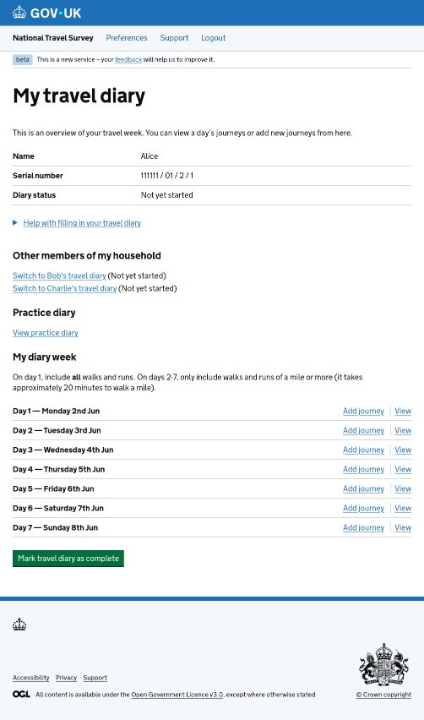
Note: All survey definitions are given in the NTS definitions manual, copies of which are available on request.
Simplified pocket size diaries or memory joggers (see Appendix G), into which respondents could briefly note down their journeys, were placed with respondents if the interviewer felt they would be helpful. The memory joggers however did not replace the need for a diary to be completed, they were simply provided as a note-taking aid.
The travel diary has gone through extensive development. A full list of changes that have been made to the paper travel diary since 2002 can be found in Appendix A4.
For 2025, the travel diaries collected information on:
purpose of journey
time left
time arrived
origin: where the journey started (from village, town or local area)
destination: where the journey ended (to village, town or local area)
method of travel (car, bus, walking)
distance (in miles)
time travelling (in minutes)
number of people in party travelling
which car or motorcycle was used (if journey was made by private transport)
ticket type: single, return or travel card (if journey was made by public transport)
cost (if journey was made by public transport)
number of boardings: the number of trains or buses. used to reach journey destination (if journey was made by public transport)
On Day 1 of the travel week, information was collected on all walks over 50 yards. However, on Days 2 to 7, only walks that were 1 mile or more were recorded (approximately equivalent to taking 20 minutes or more).
The mileage chart
For 2025, the mileage chart remained unchanged and was placed at the end of the placement interview for each household vehicle. The driver was encouraged to keep this chart in their vehicle. The chart required the driver to record the milometer reading at the start and end of the travel week. For the PB cases the mileage chart was provided to respondents as part of the doorstep recruitment stage.
See Appendix H for a copy of the mileage chart.
4.12 The reminder call
Once the digital or paper travel diary had been placed, the next stage was to remind the household to start recording their journeys on the date allocated to them, as the allocated travel week would in most cases start on a date after the placement interview. Interviewers did this either by making a reminder call visit to the household (or leaving a reminder card if the household was absent at the time the interviewer made the visit) or by making a reminder phone call. Reminder calls would usually take place one or 2 days before the start of the travel week.
4.13 The mid-week check call
Interviewers were strongly encouraged to conduct a call halfway through the travel week to motivate respondents and help them with any difficulties they might be having filling out their travel diaries. The approach to checking and editing varied between digital and paper diaries. In both cases, interviewers were strongly encouraged to conduct at least one mid-week check, either in person or over the phone, to resolve any questions and support respondents in completing their diaries.
The digital diary enabled interviewers to view the household’s diaries remotely at any time during the travel week. The mid-week check call could be either a phone call or a personal visit and was at the interviewer’s discretion, although they were encouraged to conduct an in-person check. The interviewer dashboard allowed interviewers to view respondents’ entries in real time, enabling them to identify and follow up with households without having to wait until the mid-week check or pick-up visit. Following feedback from interviewers during the parallel run, a dedicated interface was developed to facilitate navigation between the diaries of different household members, making it easier to review and edit journeys. Interviewers could also use the impersonate feature to make more substantial corrections where required.
When errors were identified, interviewers could use the interviewer notes function to record the necessary amendments. This enabled corrections to be captured efficiently without extending contact time with respondents, either in person or by telephone. The interviewer could subsequently apply the corrections through their dashboard, with the changes automatically reflected in the respondent’s digital diary.
To review and cross-check journeys reported by members of the same household, interviewers could move between individual diaries using the dedicated household interface. Any required amendments could be made directly through this interface or, where more extensive editing was needed, via the impersonation feature.
For paper diaries, interviewers could conduct the mid-week check either in person or by telephone. However, an in-person check was strongly encouraged, as it enabled interviewers to review the completed diaries directly and make any necessary corrections at that time. Interviewers would typically lay out all household members’ paper diaries side by side and cross-reference journeys on a day-by-day basis to identify inconsistencies or omissions. Any amendments made by the interviewer were recorded using a green pen to differentiate interviewer edits from respondent entries.
The proportion of households receiving a mid-week check in 2025 is shown in Table 4.11. Comparable figures for 2024 and 2019 are shown in Tables 4.12 and 4.13. These tables show the figures for each possible outcome:
a mid-week conducted by phone
a mid-week check conducted in person
no mid-week check conducted.
The table is broken down by fully co-operating and partially co-operating households.
In 2025, 98% of fully productive households had a mid-week check (either by phone or in-person), which is higher than 2024 (77%) and 2019 (80%). Of fully productive households, there was an increase in mid-week checks conducted by phone (67%) in 2025 compared to 2024 (49%). There was also a decreased in no mid-week check conducted at all in 2025 (3%) compared to 2024 (23%). This change was largely driven by the introduction of the digital diary, which enabled interviewers to review diary entries remotely and conduct checks by phone, increasing the likelihood that a mid-week check was completed rather than not undertaken.
Note: figures in the tables below may not total 100% due to rounding.
Table 4.11: Proportion of households where a mid-week check was conducted (either by phone or in-person), by fully and partially co-operating households (2025)
| Type of check | Fully co-operating | Partially co-operating | Total |
|---|---|---|---|
| Mid-week check conducted by phone | 67% | 56% | 65% |
| Mid-week check conducted in-person | 31% | 20% | 29% |
| No mid-week check | 3% | 23% | 6% |
| Base (households) | 9,037 | 1,984 | 11,021 |
Table 4.12: Proportion of households where a mid-week check was conducted (either by phone or in-person), by fully and partially co-operating households (2024)
| Type of check | Fully co-operating | Partially co-operating | Total |
|---|---|---|---|
| Mid-week check conducted by phone | 49% | 41% | 48% |
| Mid-week check conducted in-person | 28% | 18% | 27% |
| No mid-week check | 23% | 41% | 26% |
| Base (households) | 7,530 | 1,445 | 8,975 |
Table 4.13: Proportion of households where a mid-week check was conducted (either by phone or in-person), by fully and partially co-operating households (2019)
| Type of check | Fully co-operating | Partially co-operating | Total |
|---|---|---|---|
| Mid-week check conducted by phone | 50% | 33% | 48% |
| Mid-week check conducted in-person | 30% | 22% | 29% |
| No mid-week check | 20% | 44% | 23% |
| Base (households) | 6,162 | 663 | 6,825 |
4.14 The pick-up call
At the end of the travel week, the interviewer called at the household (generally within a few days) to check the travel diaries and to carry out another much shorter interview, known as the pick-up interview. The pick-up interview collected information about:
new vehicles acquired since the placement interview (for the household)
the disposal of vehicles recorded at the placement interview (for the household)
new driving licenses acquired since the placement interview (for individuals)
new season tickets acquired since the placement interview (for individuals)
mileage details (for each household vehicle)
This pick-up call was also when the mileage chart was collected, and the details transferred into the CAPI questionnaire.
After checking the digital diaries, the interviewer approved each diary and submitted the household. The digital diary data was transferred via an API from to NatCen’s Operations Department for coding. Any paper diaries were also checked before being sent back for coding by NatCen’s Operations Department.
For PB cases, the pick-up interview was conducted over the phone, and the remaining days of the travel record were completed by the interviewer during the same call. The data collected by the mileage chart was collected over the phone at this stage too.
The pick-up interview was completed on the laptop using the CAPI questionnaire, or on rare occasions using a paper questionnaire as a fallback option (with the interviewer ensuring that the paper-recorded details were transferred into the CAPI questionnaire afterwards). The paper version of the pick-up questionnaire was introduced in 2002 to enable interviewers do the pick-up interview on the doorstep where respondents were unwilling to let them into the property again. For PB cases, the pick-up interview was always completed using the CAPI questionnaire over the telephone.
Table 4.14 shows the mean length (in minutes) of pick-up interviews for 2025 and all previous survey years going back to 2002, for both fully co-operating households and the total achieved sample of co-operating households. On average, the pick-up call (including the interview and checking the travel diaries) lasted just over 18 minutes for fully productive households in 2025. This call was ideally made within 6 days of the end of the travel week. The 2025 average length of the pick-up call is higher than the previous year (13.9 in 2024).
The mean length of the pick-up interview reported here is calculated using the amount of time entered by the interviewer into the CAPI program. Although the length of pick-up is also calculated within the CAPI programme, this is not a reliable source because the pick-up interview is sometimes conducted on paper with the interviewer entering the information into the program at home. In previous technical reports, the pick-up length has not been calculated in a consistent manner. The pick-up interview lengths shown in Table 4.14 replace those in earlier NTS technical reports and are based on the interviewer-reported length.
Table 4.14: Mean length (in minutes) of pick-up interview in minutes, by fully co-operating and total co-operating households (from 2025 going back to 2002)
| Year | Fully co-operating | Total co-operating |
|---|---|---|
| 2025 | 18.2 | 18.5 |
| 2024 | 13.9 | 13.8 |
| 2023 | 14.0 | 14.0 |
| 2022 | 15.5 | 15.5 |
| 2021 | 18.1 | 18.0 |
| 2020 | 17.1 | 16.9 |
| 2019 | 14.5 | 14.4 |
| 2018 | 15.1 | 15.0 |
| 2017 | 14.7 | 14.6 |
| 2016 | 15.1 | 15.2 |
| 2015 | 15.5 | 15.3 |
| 2014 | 15.4 | 15.3 |
| 2013 | 15.1 | 15.0 |
| 2012 | 15.9 | 15.7 |
| 2011 | 16.4 | 16.3 |
| 2010 | 16.0 | 15.9 |
| 2009 | 16.4 | 16.2 |
| 2008 | 16.2 | 16.0 |
| 2007 | 16.6 | 16.4 |
| 2006 | 16.3 | 16.1 |
| 2005 | 18.6 | 18.5 |
| 2004 | 19.0 | 18.7 |
| 2003 | 18.6 | 16.3 |
| 2002 | 18.4 | 18.0 |
4.15 Diary proxying
As in previous years, the travel diary (digital and paper) was to be completed by each respondent in the house where possible. Those aged 11 and over were encouraged to complete their own diary. Proxying (in which someone else completed a diary on behalf of the respondent) was available as an option for those aged below 11 or who could not complete a diary themselves.
Setting up a proxy differs between the 2 diary modes. In the digital diary, a proxy could be nominated at the set-up stage where a respondent with their own log-in could access the proxied respondent’s diary. Only those respondents who have provided an email address could act as a proxy. More than one person could act as a proxy for a household member. A paper diary could be proxied by another respondent in the household by writing in the travel information on behalf of the proxied respondent (those under 11 are expected to be proxied).
Proxying is measured by the interviewer reporting in the CAPI questionnaire how each household member completed their diary. Another household member or interviewer completing on behalf of the respondent was used as the measure for diary proxying.
In 2025, the rates of diary proxying increased. For further information, see Understanding changes in trip rate estimates under the digital-first approach report.
Table 4.15 outlines the different approaches respondents could use to complete the diary, with a comparison between the 2 diary modes. Overall, 53% of respondents completed the diary themselves, regardless of mode. A further 32% had their diary completed by either another household member (16%) or an interviewer (16%). Proxy completion rates varied between the 2 modes: 14% of digital diaries were completed by another household member, compared with just 2% of paper diaries.
Note: figures in the tables below may not total 100% due to rounding.
Table 4.15: Types of diary completion between diary modes (2025)
| Diary completion | Digital diary | Paper diary | Total |
|---|---|---|---|
| Respondent filled it in themselves | 41% | 12% | 53% |
| Respondent filled it in with help from another household member | 6% | 1% | 8% |
| Another household member filled it in on respondent’s behalf | 14% | 2% | 16% |
| Respondent filled it in with help from the interviewer | 6% | 2% | 7% |
| Interviewer filled it in on respondent’s behalf | 11% | 5% | 16% |
| Base (individuals) | 14,442 | 4,056 | 18,498 |
Note: The figures in Table 4.15 are based on respondents aged 11 and above who had a fully completed diary
Table 4.16 shows the diary completion rates both pre- and post-pandemic. Respondents completing their own diary has decreased from 78% in 2024 to 68% in 2025. Diary proxying increased from 22% in 2024 to 32% in 2025.
Note: figures in the tables below may not total 100% due to rounding.
Table 4.16: Diary completion over the years (2019, 2024, 2025)
| Diary completion | 2019 | 2024 | 2025 |
|---|---|---|---|
| Respondent filled it in themselves | 70% | 69% | 53% |
| Respondent filled it in with help from another household member | 5% | 6% | 8% |
| Another household member filled it in on respondent’s behalf | 12% | 9% | 16% |
| Respondent filled it in with help from the interviewer | 4% | 3% | 7% |
| Interviewer filled it in on respondent’s behalf | 10% | 13% | 16% |
| Base (individuals) | 12,500 | 15,622 | 18,498 |
Note: The figures in Table 4.16 are based on respondents aged 11 and above who had a fully completed diary.
4.16 Gazetteer
The gazetteer is used to code the location of where respondents work and the origin and destination of any long-distance journeys during the CAPI interview. It is also used to code the location of journeys made in the travel record using the DES. It holds a list of locations in Great Britain which is based on 1km grid references.
After the location of the respondent’s place of work has been established through the gazetteer, a follow-up question may be asked during the interview to determine more precisely where they work in relation to a common reference point. For respondents working in larger towns and cities they would be asked whether their place of work is within a short walking distance (between 5 and 15 minutes’ walk) from the reference point for their particular town of city, such as a landmark or a main street. Likewise, for respondents working in non-urban areas they would be asked if their place of work is ‘within 5 minutes’ walk of the main shopping or business centre’. The gazetteer maps these reference points against its list of locations, details of which are provided in the lookup table in Appendix K. Respondents working in other urban areas (that is, besides the larger towns and cities for which a reference point is given) would not be asked the follow-up question.
During the interview and the data checking stage, the CAPI and DES uses the gazetteer’s grid references to calculate reasonably precise distances between each named location using checks based on straight line distances. For trips of 15 miles or over, respondents’ estimates of distance are flagged for checking if they are not between 0.75 and 1.75 ‘as the crow flies’ miles at the data processing stage. Discrepancies in distance estimates are not flagged where respondent and ‘as the crow flies’ miles are both below 15 miles.
4.17 Outcome coding
Interviewers were required to assign an outcome code to every address in their point. The fully and partially co-operating codes (110 to 130 and 241 to 262) were automatically computed for them by the CAPI program, whereas they had to input non-productive codes themselves into the CAPI program (with a small number of codes requiring office approval to be used).
Note: these fieldwork outcome codes are different to the participation categories that are used for the purposes of weighting.
For a household to be classed as fully co-operating, the placement interview had to be fully completed, and wholly filled in travel diaries had to be collected for all household members. The placement interview needed the household section, all individual interviews (whether in person or by proxy), and at least 1 vehicle section (if applicable) to be completed.
The household was coded as partially co-operating if any of the following applied, namely:
the household section of the placement questionnaire was not completed
anyone was coded as ‘not available’ for the individual section
no vehicle questionnaire sections were complete (if applicable)
travel diaries were not collected for all household members at pick-up
any of the travel diaries were incomplete (for example, missing days)
The range of possible fieldwork outcomes is shown below in Table 4.17.
Table 4.17: NTS outcome codes
| Code | Type | Outcome |
|---|---|---|
| 110 | Fully co-operating | Fully productive: All desired respondent(s) in person |
| 120 | Fully co-operating | Fully productive: Partly by desired respondent(s) in person, partly by proxy |
| 130 | Fully co-operating | Fully productive: By proxy |
| 241 | Partially co-operating | Partial productive: Desired respondent(s) in person, with some travel records |
| 242 | Partially co-operating | Partial productive: Desired respondent(s) in person, with no travel records |
| 251 | Partially co-operating | Partial productive: Partly by desired respondent(s) in person, partly by proxy, with some travel records |
| 252 | Partially co-operating | Partial productive: Partly by desired respondent(s) in person, partly by proxy, with no travel records |
| 261 | Partially co-operating | Partial productive: By proxy, with some travel records |
| 262 | Partially co-operating | Partial productive: By proxy, with no travel records |
| 310 | Non-contact | No contact with anyone at address |
| 321 | Non-contact | Contact made, but not at selected dwelling unit (used only for addresses with multiple dwelling units) |
| 322 | Non-contact | Contact made at (selected) household but not with responsible adult |
| 328 | Non-contact | Multi-household dwelling units only: contact made at (selected) dwelling unit, but not with anyone from selected household |
| 333 | Non-contact | Household opt-in, but telephone number wrong |
| 410 | Refusal | Office refusal |
| 421 | Refusal | Information refused about number of DUs at address |
| 428 | Refusal | Contact made but information refused about number of households |
| 431 | Refusal | Refusal before interview |
| 432 | Refusal | Proxy refusal |
| 433 | Refusal | Refusal of face-to-face interview due to COVID-19, no agreement for remote interview |
| 440 | Refusal | Refusal during interview |
| 450 | Refusal | Broken appointment, no recontact |
| 510 | Other unproductive | Ill at home during survey period |
| 520 | Other unproductive | Away or in hospital during survey period |
| 530 | Other unproductive | Physically or mentally unable/incapable |
| 540 | Other unproductive | Language difficulties |
| 550 | Other unproductive | OFFICE APPROVAL ONLY: Lost productive |
| 561 | Other unproductive | Household member ill with COVID-19 or related symptoms |
| 563 | Other unproductive | Household member is shielding from COVID-19 |
| 565 | Other unproductive | Household has been instructed to self-isolate |
| 591 | Other unproductive | Interview completed but respondent requested deletion |
| 599 | Other unproductive | OFFICE APPROVAL ONLY: Other unproductive |
| 612 | Unknown eligibility: no contact made | OFFICE APPROVAL ONLY: Issued, but not attempted |
| 614 | Unknown eligibility: no contact made | OFFICE APPROVAL ONLY: Issued, but not attempted due to COVID-19 local lockdowns |
| 620 | Unknown eligibility: no contact made | OFFICE APPROVAL ONLY: Inaccessible |
| 621 | Unknown eligibility: no contact made | OFFICE APPROVAL ONLY: Inaccessible due to COVID-19 |
| 630 | Unknown eligibility: no contact made | OFFICE APPROVAL ONLY: Unable to locate address |
| 640 | Unknown eligibility: no contact made | Unknown whether address contains residential, no contact made after 6 or more calls |
| 650 | Unknown eligibility: no contact made | Residential address, unknown if occupied due to no contact made after 6 or more calls |
| 690 | Unknown eligibility: no contact made | Other unknown eligibility (no contact made) |
| 710 | Ineligible or deadwood | Not yet built or under construction |
| 720 | Ineligible or deadwood | Demolished or derelict |
| 730 | Ineligible or deadwood | Vacant or empty |
| 740 | Ineligible or deadwood | Non-residential address (for example: business, school, office, factory, etc.) |
| 750 | Ineligible or deadwood | Address occupied, but no resident household (for example: holiday or weekend home) |
| 760 | Ineligible or deadwood | Communal establishment or institution, no private dwellings |
| 770 | Ineligible or deadwood | Residential, but not eligible for survey (for example, no-1 aged 16 and over) |
| 780 | Ineligible or deadwood | OFFICE USE ONLY: Address out of sample |
| 790 | Ineligible or deadwood | Other ineligible |
| 810 | Unknown eligibility: contact made | Information refused about whether address is residential |
| 820 | Unknown eligibility: contact made | Contact made, but not with someone who can confirm the presence of a residential household |
| 830 | Unknown eligibility: contact made | Information refused about whether resident(s) are eligible |
| 850 | Unknown eligibility: contact made | Unable to confirm eligibility due to language difficulties |
| 890 | Unknown eligibility: contact made | Other unknown eligibility (contact made) |
Addresses which were not issued to an interviewer or which were issued but not coded out (and therefore deemed to be unworked) were defaulted to the outcome code of 612 at the end of fieldwork for the quota month.
4.18 The shopping voucher incentive and thank you letter
Each member of the fully responding household was given a £5 shopping voucher (in the form of a physical gift card) by interviewers at the end of the pick-up call. Interviewers explained to respondents that the gift card would be activated by the office within 2 to 3 working days. For PB cases, the same £5 incentive was used, but this was sent out by NatCen’s Operations Department due to the fact that the pick-up call would have been conducted over the phone.
Starting in 2019, interviewers also handed out a thank you letter at the end of the pick-up call (see Appendix J1). The thank you letter was addressed from the DfT and given as a recognition of the respondents’ time and effort. For PB cases, an equivalent letter was mailed out by the Operations Department along with the gift card(s) (see Appendix J2).
4.19 Response rates
Tables 4.18 to 4.21 show the response rates in 2025 for England as a whole (the national response rate), the response for Inner London and Outer London, and finally the response for the rest of England excluding London. These tables show the response rate for the Achieved Sample, which includes all sampled addresses, and also the Standard Response Rate, which includes eligible households only and is the measure by which response is monitored year on year.
The overall national Standard Response Rate in 2025 was 28%. This was higher in Inner London (30%), but slightly lower in Outer London (26%). The response rate for the rest of England (excluding London) was 28%.
Table 4.18: NTS National (England) response rates
| Category | Achieved Sample | Achieved Sample Response Rate | Standard Response Rate |
|---|---|---|---|
| Set sample | 35,156 | 100% | not applicable |
| Ineligible or deadwood | 2,498 | 7% | not applicable |
| Unknown eligibility | 3,081 | 9% | not applicable |
| Eligible households | 32,418 | 92% | 100% |
| Fully co-operating | 9,037 | 26% | 28% |
| Partially co-operating | 1,984 | 6% | 6% |
| Refusal to co-operate and other unproductive | 15,525 | 44% | 55% |
| Non-contact | 3,031 | 9% | 11% |
Table 4.19: NTS Inner London response rates
| Category | Achieved Sample | Achieved Sample Response Rate | Standard Response Rate |
|---|---|---|---|
| Set sample | 2,618 | 100% | not applicable |
| Ineligible or deadwood | 177 | 7% | not applicable |
| Unknown eligibility | 198 | 8% | not applicable |
| Eligible households | 2,427 | 93% | 100% |
| Fully co-operating | 732 | 28% | 30% |
| Partially co-operating | 126 | 5% | 5% |
| Refusal to co-operate and other unproductive | 1,178 | 45% | 55% |
| Non-contact | 207 | 8% | 10% |
Table 4.20: NTS Outer London response rates
| Category | Achieved Sample | Achieved Sample Response Rate | Standard Response Rate |
|---|---|---|---|
| Set sample | 660 | 100% | not applicable |
| Ineligible or deadwood | 42 | 6% | not applicable |
| Unknown eligibility | 2 | 0% | not applicable |
| Eligible households | 618 | 94% | 100% |
| Fully co-operating | 161 | 24% | 26% |
| Partially co-operating | 46 | 7% | 7% |
| Refusal to co-operate and other unproductive | 362 | 55% | 59% |
| Non-contact | 47 | 7% | 8% |
Table 4.21: NTS England excluding London response rates
| Category | Achieved Sample | Achieved Sample Response Rate | Standard Response Rate |
|---|---|---|---|
| Set sample | 31,878 | 100% | not applicable |
| Ineligible or deadwood | 2,279 | 7% | not applicable |
| Unknown eligibility | 2,881 | 9% | not applicable |
| Eligible households | 29,373 | 92% | 100% |
| Fully co-operating | 8,144 | 26% | 28% |
| Partially co-operating | 1,812 | 6% | 6% |
| Refusal to co-operate and other unproductive | 13,985 | 44% | 55% |
| Non-contact | 2,777 | 9% | 11% |
As mentioned in section 3.4 the NTS oversamples Inner and Outer London with the aim of achieving responding sample sizes that reflect the regional distribution without the need for corrective weighting. The degree of oversampling in 2025 was based on estimates of differences in response rates between Inner London, Outer London and the rest of England.
From 2006 onwards, weights were introduced in order to correct for non-response (see Chapter 6 for a detailed description of the weighting). Data back to 1995 have been weighted retrospectively.
4.20 Back-checking and quality control
Like all NatCen projects in the field, the NTS was back-checked to ensure that interviewers were working to the standards to which they were trained and in accordance with the specific project requirements on which they were briefed.
A minimum of 10% of the total productive interviews were back-checked, the majority (usually 90%) by telephone, but where this was not possible (usually 10%) by letter. If the responses received indicated significant deviations from the standards set, a supervisor was asked to personally revisit the address(es) concerned. Back-checking was carried out usually within 2 weeks, and always within 4 weeks, of the interview date. The back-checking exercise did not find any systematic errors in the way interviewers were working for 2025.